Part 1
Part 2

Thursday, 6 May 2010

Wednesday, 5 May 2010
Édouard Manet - A Bar at the Folies-Bergère (1882)

This is an unusual portrait because it is of someone at work, and someone who to our eyes is defined by her work and is profoundly unhappy with it. She is alienated from her surroundings, as if there is a glass pane between her and everyone else in the room - the drinkers, chatters-up, lovers, liars, thieves and businessmen. Manet conveys Suzon's estrangement from her world by the fact that she is the only person in this painting who is not reflected in glass. Everyone else in the painting is seen in the big bar mirror: the quickly painted, harshly reflected faces and bodies, a woman in gloves with her lover or client, someone else looking at the scene with binoculars. They are objects she is looking at - but at one remove, through a glass darkly.
The only solid realities are the marble bar top and the bottles - crème de menthe, champagne, beer - a bowl of oranges, two flowers delicately placed in a vase. She has both hands firmly on the bar as if she needs to touch something solid, in case she should be carried away by the vortex of light and shapes reflected in the mirror.
This is not a realistic painting of the Folies-Bergère. Suzon did work there, but she posed for the painting in Manet's studio, behind a table laden with bottles. He merged this image with rapid painted sketches he made at the Folies-Bergère. There is no attempt to make the image cohere: there is, as contemporary critics pointed out, an inconsistency to the relationship between the reflections in the mirror and the real things. The man in the top hat approaching Suzon in a sinister way in the top right hand corner of the mirror would in reality have to be standing with his back to us in front of the bar, and Suzon herself should be reflected in an entirely different place.
The dislocation of Suzon's world is deliberate. Paris is a hall of mirrors where Suzon floats helplessly, clinging to her bar. The flowers are a touching attempt to preserve a little humanity, as are her neat blue clothes and whole demeanour. It's amazing that contemporary critics saw her as a prostitute.
And who are you? The top-hatted stranger, of course, the Jack the Ripper whose ghostly reflection approaches her with such menace in the mirror. Manet captures the coolness, cruelty and glamour of modern life. This is one of the keystones of modern art.
full guardian article
The Painting was the inspiration for John Brack's 1954 painting 'The Bar', again the patrons can be seen in a sinister light in the mirror behind the barmaid.

Tuesday, 4 May 2010
Suzanne Valadon - Portrait of Miss Lily Walton avec Raminou
Better known as a model but an excellent painter in her own right, Suzanne Valadon posed for artists including Renoir, Toulouse-Lautrec & Modigliani. The portrait of Lily Walton and its almost degas-esque quality is a beauty.
Portrait of Miss Lily Walton avec Raminou (1922)

The Bath (1908)

Photograph of Suzanne Valadon

Here's some of her more famous appearences...
Renoir - Dance at Bougival

Renoir - Girl Braiding her hair

Henri Toulouse-Lautrec - The Hangover

here's a brief bio from artblogbybob
Portrait of Miss Lily Walton avec Raminou (1922)

The Bath (1908)

Photograph of Suzanne Valadon

Here's some of her more famous appearences...
Renoir - Dance at Bougival

Renoir - Girl Braiding her hair

Henri Toulouse-Lautrec - The Hangover

here's a brief bio from artblogbybob
Friday, 30 April 2010
Henri Rousseau & the Eiffel Tower
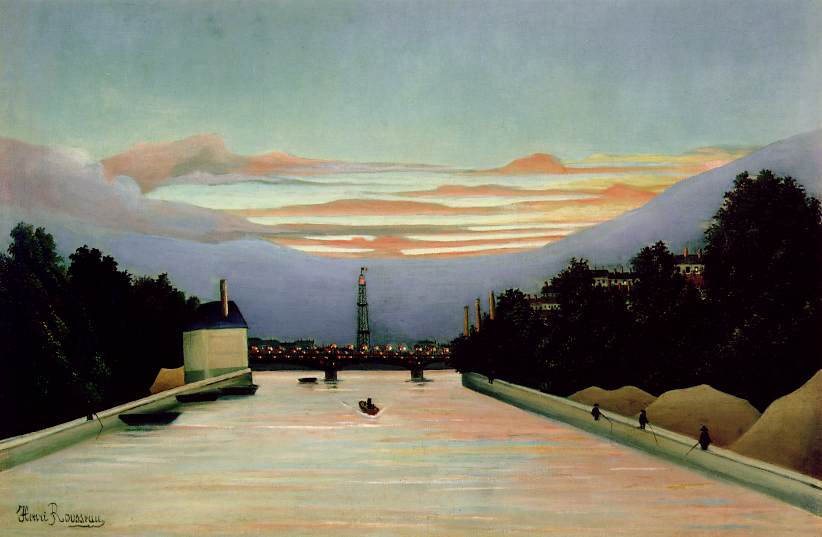

At his funeral, seven friends stood at his grave in the Cimetière de Bagneux: the painters Paul Signac and Manuel Ortiz de Zárate, the artist couple Robert Delaunay and Sonia Terk, the sculptor Brancusi, Rousseau's landlord Armand Queval and Guillaume Apollinaire who wrote the epitaph Brancusi put on the tombstone:
We salute you Gentle Rousseau you can hear us.
Delaunay, his wife, Monsieur Queval and myself.
Let our luggage pass duty free through the gates of heaven.
We will bring you brushes paints and canvas.
That you may spend your sacred leisure in the
light and Truth of Painting.
As you once did my portrait facing the stars, lion and the gypsy
Thursday, 29 April 2010
Egon Schiele - Death & the Maiden (& more...)
Schiele's work is noted for its intensity, and the many self-portraits the artist produced. The twisted body shapes and the expressive line that characterize Schiele's paintings and drawings mark the artist as an early exponent of Expressionism, although still strongly associated with the art nouveau movement (Jugendstil).
Some view Schiele's work as being grotesque, erotic, pornographic, or disturbing, focusing on sex, death, and discovery. He focused on portraits of others as well as himself. In his later years, while he still worked often with nudes, they were done in a more realist fashion.
In 1914, Schiele glimpsed the sisters Edith and Adéle Harms, who lived with their parents across the street from his studio in the Viennese suburb of Hietzing, 101 Hietzinger Hauptstrasse. They were a middle-class family and Protestant by faith; their father was a master locksmith. In 1915, Schiele chose to marry the more socially acceptable Edith, but had apparently expected to maintain a relationship with Wally. However, when he explained the situation to Wally, she left him immediately and never saw him again. This abandonment lead him to paint Death and the Maiden, where Wally's portrait is based on a previous pairing, but Schiele's is newly struck. (In February 1915, Schiele wrote a note to his friend Arthur Roessler stating: "I intend to get married, advantageously, perhaps not to Wally.") Despite some opposition from the Harms family, Schiele and Edith were married on 17 June 1915, the anniversary of the wedding of Schiele's parents.
text from wikipedia
Death & the Maiden

Four Trees


Wednesday, 28 April 2010
Gustave Caillebotte - Paris Street, Rainy Day (1877)

Caillebotte's style belongs to the School of Realism but was strongly influenced by his Impressionist associates. In common with his precursors, Jean-Francois Millet and Gustave Courbet, as well his contemporary Degas, Caillebotte aimed to paint reality as it existed and as he saw it, hoping to reduce painting's inherent theatricality. Perhaps because of his close relationship with so many of his peers, his style and technique varies considerably among his works, as if “borrowing” and experimenting, but not really sticking to any one style. At times, he seems very much in the Degas camp of rich-colored realism (especially his interior scenes) and at other times, he shares the Impressionists' commitment to "optical truth" and employs an impressionistic pastel-softness and loose brush strokes most similar to Renoir and Pissarro, though with a less vibrant palette.
wikipedia
Paris Street, Rainy Day
With an almost photograhic feel, it seems to me that the main focus is of the main in the centre with his head down approaching the curb. This is achieved without putting the main figures completely out of focus but just enough to allow the eye to drift over them.
Subscribe to:
Posts (Atom)