Tuesday, 8 June 2010

Alexej von Jawlensky

The human face became the only theme which interested him, and its essential architecture - the cross of the nose and the arch of the eyebrows, the mouth, the oval of the chin, the forehead - determined the symbolic composition of the picture, a new form of iconography stamped with a profound mystical religious sense. 'Art is nostalgia for God', Jawlensky often said.

From 'A dictionary of Modern Art

The Hunchback

Girl in blue apron

---can't find title---

girl with a green face

Portrait of a dancer, Alexander Sakharoff

Monday, 7 June 2010

Roland Oudot

Oudot belongs to a group of artists who, without trying to shock, have asserted them selves between the two wars and been given the name of 'Painters of the poetic reality'. They are generally considered as the final product of Impressionism. This has meant giving Impressionism and its consequences an interpretation that the movement certainly did not have at the beginning; and it is not because these painters have taken the landscape as an essential theme that they should be credited with Impressionist descent; Oudot's art has, in fact, a fixity that contradicts the mobility of Impressionism. His large blue skies, his dominant greys, his slate tones are the opposite of scintillating light; he seeks stability rather than instantaneity.

He is one that will remain true to a very classical conception of art, in which an always controlled emotion admits of no facility. Nature remains his inspiration under all circumstances, but it is Nature conceived anew, seen through a tense, penetrating sensitivity that is never lacking.


Text from 'A dictionary of Modern painting'

Lot No 112


Two Young Women Bathing in the Woods


Venice


Cemin dans la campagne

Friday, 4 June 2010

James Ensor - sinister sans surreal

James Sidney Edouard, Baron Ensor (April 13, 1860 – November 19, 1949) was a Belgian painter and printmaker who had ties to both the expressionists and impressionists as well as the old flemish painters of yester-year. He creates astoundingly sinister masked figures and makes them look relatively normal. However good the masks are, I cannot help but find the 'Skeletons fighting over a pickled herring' the most unnerving and jovial at the same time, a brilliant portrayal of an unexpected subject.

Skeletons fighting over a pickled herring


The intrigue


Scandelized Masks


Entry of Christ into Brussels

Thursday, 3 June 2010

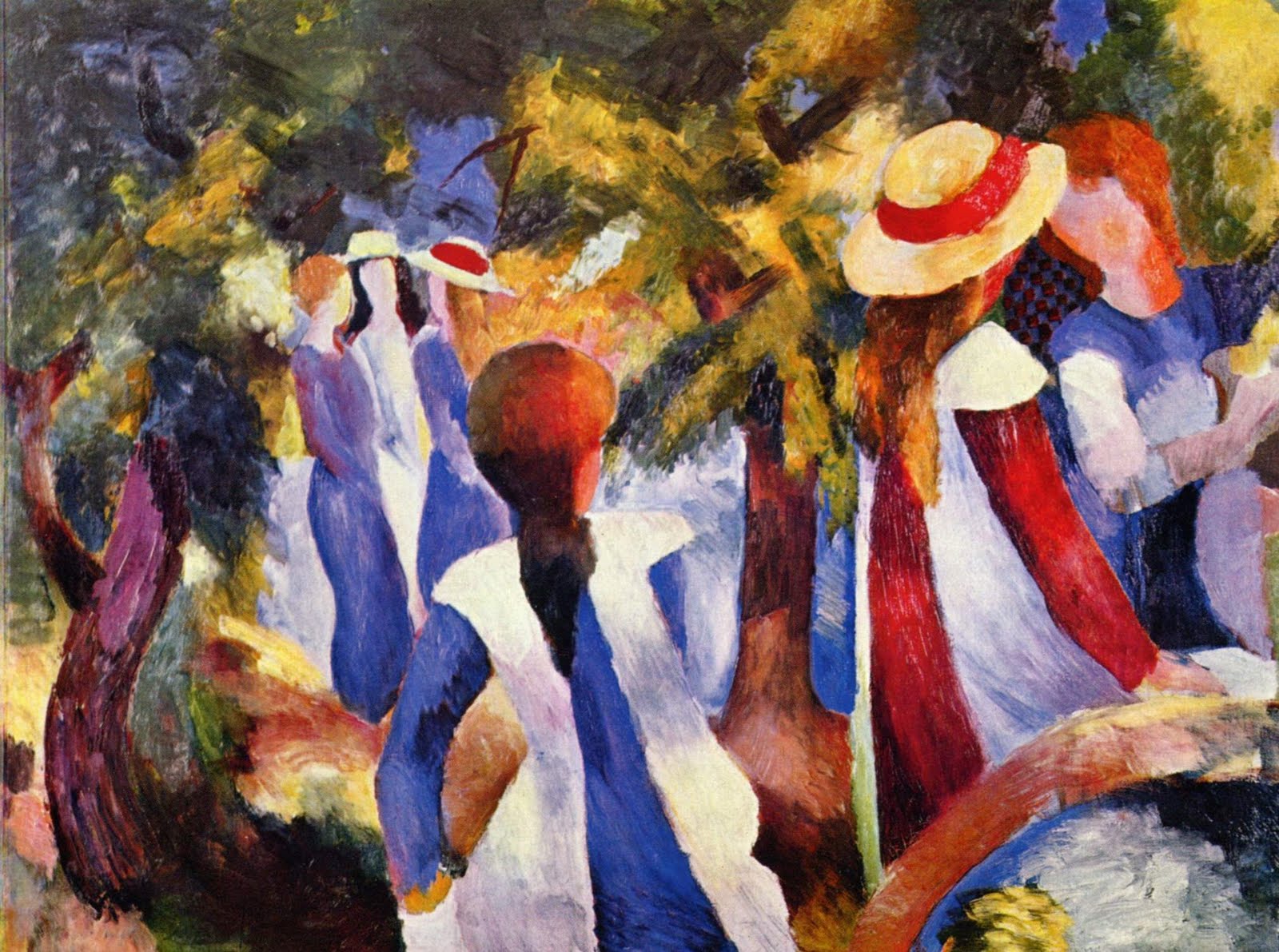
August Macke - Lady in a green jacket

August Macke (3 January 1887 – 26 September 1914) was one of the leading members of the German Expressionist group Der Blaue Reiter (The Blue Rider). He lived during a particularly innovative time for German art which saw the development of the main German Expressionist movements as well as the arrival of the successive avant-garde movements which were forming in the rest of Europe. Like a true artist of his time, Macke knew how to integrate into his painting the elements of the avant-garde which most interested him.

Macke's meeting with Robert Delaunay in Paris in 1912 was to be a sort of revelation for him. Delaunay's chromatic Cubism, which Apollinaire had called Orphism, influenced Macke's art from that point onwards. His Shops Windows can be considered a personal interpretation of Delaunay's Windows, combined with the simultaneity of images found in Italian Futurism. The exotic atmosphere of Tunisia, where Macke traveled in 1914 with Paul Klee and Louis Moilliet was fundamental for the creation of the luminist approach of his final period, during which he produced a series of works now considered masterpieces. August Macke's oeuvre can be considered as Expressionism (the movement that flourished in Germany between 1905 and 1925), and also as part of Fauvism. The paintings concentrate primarily on expressing feelings and moods rather than reproducing objective reality, usually distorting colour and form.

Macke's career was cut short by his early death at the front in Champagne in September 1914, the second month of World War I. His final painting, Farewell, depicts the mood of gloom that settled after the outbreak of war.

text from wikipedia (where else)

Lady in a green jacket (1913)

Girls Under Trees

Hutladen

Church in Kandern

Farewell (1914)


Here is an extract from a letter Robert Delaunay wrote to August Macke...

"For me, every man distinguishes himself by his essence his personal movement, as opposed to that which is universal. That is what I found in your works that I saw this winter at Cologne. You are not in direct communication with nature, the only source of inspiration directed toward beauty.' Such communication affects representation in its most vital and critical aspect. This communication alone, by the comparison of the antagonisms, rivalries, movements which give birth to decisive moments, permits the evolution of the soul, whereby a man realizes himself on earth. It is impossible to be concerned with anything else in art."
read the whole thing

Wednesday, 2 June 2010

Maya Deren - Ritual in Transfigured Time (1946)

More silent brilliance from Maya Deren


Maya Deren - Ritual in Transfigured Time (1946)
Ritual In Transfigured Time (1946) silently follows Rita Christiani's perspective as she enters an apartment to find Maya Deren immersed in the ritual of unwinding wool from a loom. Deren includes another expression of the external invading the internal with a strange wind that surrounds and entrances her as she becomes transported by the ritual. Ritual in Transfigured Time links the looming ritual with the ritual of the social greeting. Christiani enters a party, meets and greets, moving throughout the crowd like a dancer. Her movements become increasingly expressive and fluid, the ritual becomes a performance. Key themes in this film are the dread of rejection and the contrasting freedom of expression in the abandonment to the ritual.

Pierre Roy - Danger on the Stairs

Pierre Roy a relative of the famous French writer Jules Vernes was borned in Nantes in 1880. One of the original surrealists, Roy may be considered an immediate father of magic realism or superrealism. When he was 30 he met fauvist creators and writers Salmon, Appolinaire and Max Jacob. Later he met Paul Eluard, Philippe Soupault, Marcel Duchamp and Picabia and became interested in surrealism. The first group exhibition of surrealist artists was in 1925 at the Galerie Pierre; it included Jean Arp, Giorgio de Chirico, Max Ernst, Paul Klee, Andre Masson, Joan Miro, Man Ray, Picasso and Pierre Roy.
Unusual and "mystère onirique" are the keys to his work which represents, in meticulous detail, recognizable scenes and objects which are taken out of natural context, distorted and combined in fantastic ways as they might be in dreams; its sources are in the art of fauvist painter Henri Rousseau and also De Chirico who was a very good friend of him. Danger on the Stairs, 1927 or 1928 is an overt example of fantastic dissociation, but nonetheless effective for that. Pierre Roy is especially appreciated in the United States where he often exhibited his paintings; several of them were reproduced on the cover of Vogue magazine. Among his admirors were Jean Cocteau and Aragon.

text from www.mcs.csueastbay.edu

Danger on the stairs

Une journée à la campagne

Amusing physique

Tuesday, 1 June 2010

Maya Deren - Meshes of the Afternoon


Throughout the 1940s and 50s, Deren attacked Hollywood for its artistic, political and economic monopoly over American cinema. She stated, “I make my pictures for what Hollywood spends on lipstick,” and observed that Hollywood “has been a major obstacle to the definition and development of motion pictures as a creative fine-art form.” She set herself in opposition to the Hollywood film industry’s standards and practices.