
Wednesday, 28 April 2010

Gustave Caillebotte - Paris Street, Rainy Day (1877)

Caillebotte's style belongs to the School of Realism but was strongly influenced by his Impressionist associates. In common with his precursors, Jean-Francois Millet and Gustave Courbet, as well his contemporary Degas, Caillebotte aimed to paint reality as it existed and as he saw it, hoping to reduce painting's inherent theatricality. Perhaps because of his close relationship with so many of his peers, his style and technique varies considerably among his works, as if “borrowing” and experimenting, but not really sticking to any one style. At times, he seems very much in the Degas camp of rich-colored realism (especially his interior scenes) and at other times, he shares the Impressionists' commitment to "optical truth" and employs an impressionistic pastel-softness and loose brush strokes most similar to Renoir and Pissarro, though with a less vibrant palette.
wikipedia
Paris Street, Rainy Day
With an almost photograhic feel, it seems to me that the main focus is of the main in the centre with his head down approaching the curb. This is achieved without putting the main figures completely out of focus but just enough to allow the eye to drift over them.
Tuesday, 27 April 2010
Amedeo Modigliani - Portrait of Maude Abrantes (1907)
Following on from yesterday's post on Henri Toulouse-Lautrec here's Modigliani, i came across him through the potrait he'd painted of the godlike Blaise Cendrars, and in doing so found this portrait of Maude Abrantes, which is exceptional, the way he captures the tired hazy absinsth induced stupor that she submits herself to is quite spectacular.

During the 1920s, in the wake of Modigliani's career and spurred on by comments by André Salmon crediting hashish and absinthe with the genesis of Modigliani's style, many hopefuls tried to emulate his "success" by embarking on a path of substance abuse and bohemian excess. Salmon claimed—erroneously—that whereas Modigliani was a totally pedestrian artist when sober,
“ ...from the day that he abandoned himself to certain forms of debauchery, an unexpected light came upon him, transforming his art. From that day on, he became one who must be counted among the masters of living art.[14] ”
While this propaganda served as a rallying cry to those with a romantic longing to be a tragic, doomed artist, these strategies did not produce unique artistic insights or techniques in those who did not already have them.
In fact, art historians suggest[14] that it is entirely possible for Modigliani to have achieved even greater artistic heights had he not been immured in, and destroyed by, his own self-indulgences. We can only speculate what he might have accomplished had he emerged intact from his self-destructive explorations.
Here is the portrait he did of Blaise Cendrars

Monday, 26 April 2010
Henri Toulouse-Lautrec - Self Portrait in crowd, at the Moulin Rouge
He may be considered a drunk and a martyr and thought of most fondly for his iconic Moulin Rouge Posters, but Henri Toulouse-Lautric was also a painter of real brilliance, upon seeing his 'self portrait in crowd...' it is difficult for it to not take an effect, the saturated colours, the shadow, the perspective and the real emotion visible on the faces of the crowd. I believe it to be Lautrec sat with the beard at the main table.
Self Portrait in the crowd, at the Moulin Rouge

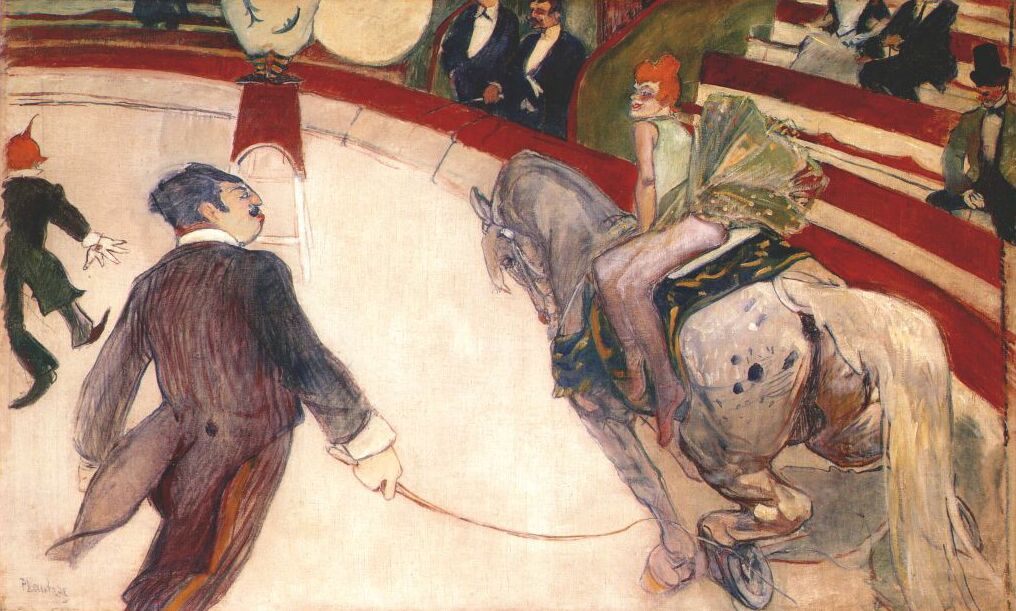
At the Cirque Fernando - this painting really reminds me of the the Circus by George Seurat, the horse and rider seem to be almost carbon copies of each other, I believe Lautrec created his first.

Marcelle Lender doing the bolero in 'Chilperic'

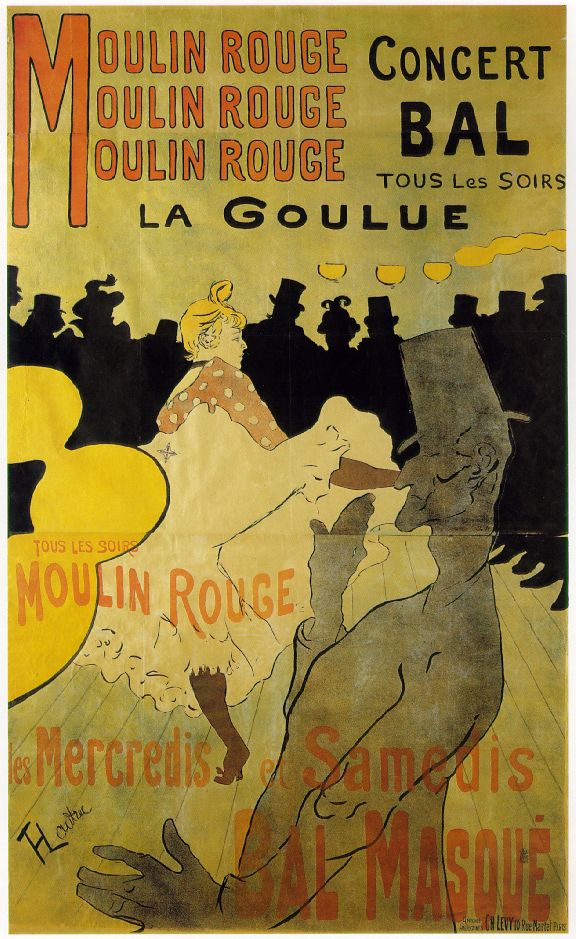
Moulin Rouge poster

bio from Wikipedia
Henri Marie Raymond de Toulouse-Lautrec-Monfa or simply Henri de Toulouse-Lautrec (French pronunciation: [ɑ̃ʁi də tuluz loˈtʁɛk]) (24 November 1864 – 9 September 1901) was a French painter, printmaker, draughtsman, and illustrator, whose immersion in the colourful and theatrical life of fin de siècle Paris yielded an œuvre of exciting, elegant and provocative images of the modern and sometimes decadent life of those times. Toulouse-Lautrec is known along with Cézanne, Van Gogh, and Gauguin as one of the greatest painters of the Post-Impressionist period. In a 2005 auction at Christie's auction house a new record was set when "La blanchisseuse", an early painting of a young laundress, sold for $22.4 million U.S.
Self Portrait in the crowd, at the Moulin Rouge

At the Cirque Fernando - this painting really reminds me of the the Circus by George Seurat, the horse and rider seem to be almost carbon copies of each other, I believe Lautrec created his first.
Marcelle Lender doing the bolero in 'Chilperic'

Moulin Rouge poster
bio from Wikipedia
Henri Marie Raymond de Toulouse-Lautrec-Monfa or simply Henri de Toulouse-Lautrec (French pronunciation: [ɑ̃ʁi də tuluz loˈtʁɛk]) (24 November 1864 – 9 September 1901) was a French painter, printmaker, draughtsman, and illustrator, whose immersion in the colourful and theatrical life of fin de siècle Paris yielded an œuvre of exciting, elegant and provocative images of the modern and sometimes decadent life of those times. Toulouse-Lautrec is known along with Cézanne, Van Gogh, and Gauguin as one of the greatest painters of the Post-Impressionist period. In a 2005 auction at Christie's auction house a new record was set when "La blanchisseuse", an early painting of a young laundress, sold for $22.4 million U.S.
Friday, 16 April 2010
Emile Nolde - Sea with Red Sun and more...
Sea with Red Sun

Drifting Clouds

Not sure of the title of this...

”….Nolde sees the Sea devoid of any reference to man, eternally in motion, ever changing….” Max Sauerlandt,
see more here...panathinaeos.wordpress.com

Drifting Clouds

Not sure of the title of this...

”….Nolde sees the Sea devoid of any reference to man, eternally in motion, ever changing….” Max Sauerlandt,
see more here...panathinaeos.wordpress.com
Monday, 12 April 2010
Tuesday, 9 March 2010
Subscribe to:
Posts (Atom)